Queue Management System in Saudi Arabia: 2026 Buyer Guide
A modern queue management system in Saudi Arabia has moved from a nice-to-have counter gadget to a core part of how banks, clinics, and government service centres run their floors. Vision 2030 pushed customer experience to the top of the agenda, and long, chaotic lines simply do not fit that story. In this guide I walk through how these systems actually work, what to budget for in 2026, and how smart branches pair a lobby queue with an outdoor lane.
I have watched a single ticket kiosk cut walk-aways at a busy Riyadh service centre by a noticeable margin within weeks. The technology is not magic, but the discipline it brings to a lobby is real. Let us break it down.
What a queue management system does day to day
At its simplest, the system replaces the messy scrum near a counter with a fair, visible order of service. A visitor picks a service, receives a ticket, and waits until a display or voice announcement calls the number. Behind that calm front end sits a lot of useful logic.
- Ticketing by service type, so a bill payment does not sit behind a complex account opening.
- Routing that sends each ticket to the counter with the right skills.
- Live dashboards showing wait times, service times, and staff load.
- Feedback capture at the counter or on a small pad after service.
The staff win here matters as much as the customer win. Supervisors stop guessing where the bottleneck is because the numbers are on screen in real time.
Core hardware and software pieces
Most deployments share the same building blocks: a self-service ticket kiosk, main and counter displays, a controller or server, and a management console. Add-ons like SMS alerts, mobile ticketing, and appointment booking layer on top when a branch is ready for them.
How much does a queue system cost in 2026?
Pricing depends on branch count, the number of counters, and whether you want cloud reporting. The table below gives realistic planning ranges for the Kingdom rather than a single sticker price.
| Setup size | Typical counters | Indicative range (SAR) | Best fit |
|---|---|---|---|
| Single small branch | 2 to 4 | 8,000 to 20,000 | Clinics, small offices |
| Mid branch | 5 to 10 | 20,000 to 55,000 | Banks, telecom stores |
| Enterprise / multi-site | 10+ per site | Custom, cloud-based | Ministries, hospital chains |
Treat these as directional. A proper site survey always changes the picture, and cloud reporting usually shifts part of the cost into an annual subscription instead of upfront hardware.
Why Saudi service centres are upgrading now
Three forces converge in 2026. First, citizen expectations keep rising as digital government services set a high bar. Second, labour costs make wasted staff time expensive, so branches want data on where minutes leak. Third, health-conscious visitors still prefer not to crowd a counter, and orderly spacing helps.
The Saudi Data and Artificial Intelligence Authority has publicly championed data-driven public services across the Kingdom, and queue analytics feed directly into that goal. You can read more about the national direction on the SDAIA official portal.
The link between lobby flow and outdoor lanes
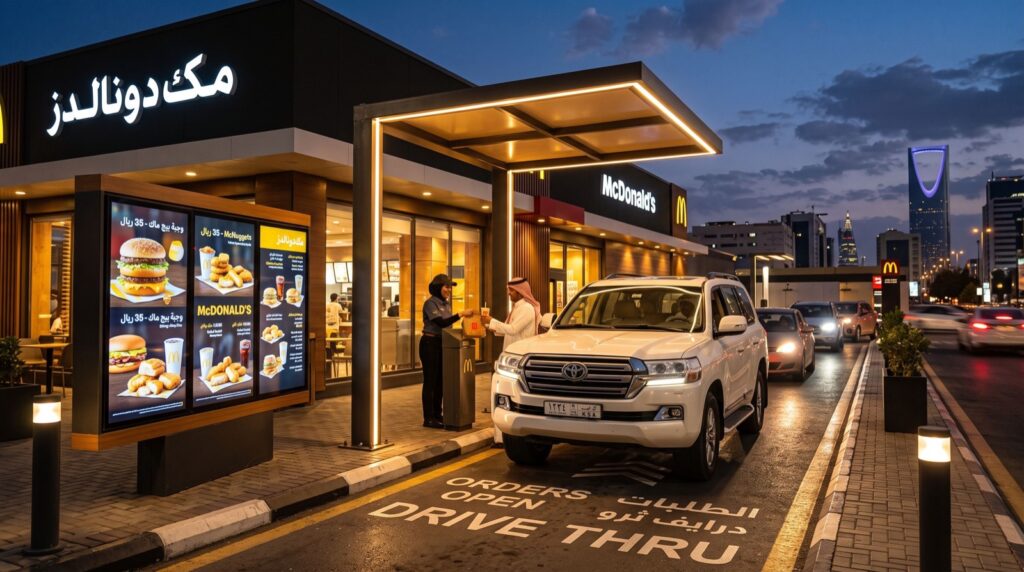
Restaurants, pharmacies, and coffee brands rarely stop at the front desk. They also want to serve customers who never leave the car. That is where Drive-thru Systems in Saudi Arabia come in, extending the same order-and-serve discipline to a lane with headsets, order confirmation boards, and timers. Pairing an indoor queue management system in saudi arabia with an outdoor lane gives one operations team a single view of both channels.
How do I choose the right vendor?
Do not start with the flashiest touchscreen. Start with your service map. List every service you offer, the average handling time, and the peak hours. A vendor who asks for that data before quoting understands the problem. One who quotes blind does not.
- Confirm the system supports Arabic and English on every screen and ticket.
- Ask for live dashboard access during the demo, not screenshots.
- Check whether reporting is exportable for your own analysis.
- Verify local support hours and spare-part availability inside the Kingdom.
- Test the appointment and SMS features with your real numbers.
When you shortlist installers, look for dependable specialists who can survey the site, wire it cleanly, and train staff rather than just drop boxes at the door.
Practical tip from the floor
Set your first two weeks as a tuning window. Watch which service categories overflow, then rebalance staff or split a category. A queue system exposes reality fast, so use that first fortnight to fix the process, not just the signage.
Measuring success after go-live
Pick a small set of numbers and track them weekly. Average wait time, average service time, abandonment rate, and a simple satisfaction score cover most needs. Improvement should be visible within a month if the configuration matches your traffic.
Share those numbers with counter staff. When people see their own service times trending down, the system becomes a shared tool instead of a surveillance box, and adoption sticks.
Common mistakes to avoid
Even good branches trip over the same avoidable errors. The most frequent is buying more counters of hardware than the service map justifies, which wastes budget and confuses customers. The second is treating the launch date as the finish line rather than the start of tuning.
Another quiet mistake is ignoring the entrance. If visitors cannot find the ticket kiosk within a few steps of walking in, they will drift toward a counter and undo the whole system. Place the kiosk on the natural path, add clear bilingual signage, and station a greeter for the first week.
- Do not over-buy hardware before you know your real peaks.
- Do not skip the two-week tuning window.
- Do not hide the ticket kiosk away from the entrance.
- Do not forget spare-part and support terms in the contract.
Integrations worth planning early
Think ahead about links to your CRM, appointment booking, and any SMS gateway. Wiring these in during the initial configuration is far cheaper than bolting them on later. Even if you do not switch them on at launch, choosing a platform that supports them keeps your future options open.
Frequently Asked Questions
Is a queue management system suitable for small clinics?
Yes. A two to four counter setup is affordable and cuts the front-desk crush quickly. Small clinics often see the fastest satisfaction gains because their lobbies were the most crowded relative to size.
Can one platform run both a lobby queue and a drive-thru lane?
Many can. A unified platform lets a single team monitor indoor tickets and outdoor lane timing together, which simplifies staffing and reporting across both service channels.
Does the system support Arabic language screens?
Reputable systems in the Kingdom are fully bilingual, showing Arabic and English on kiosks, main displays, and printed tickets so every visitor is served comfortably.
How long does installation usually take?
A single branch is often live within a day or two after cabling and configuration. Multi-site rollouts are scheduled in phases so each location gets proper testing and staff training.
Conclusion
A well-chosen queue management system in Saudi Arabia turns a stressful lobby into a measurable, calm operation, and pairing it with a modern drive-thru lane extends that order to every customer. Map your services, insist on bilingual screens and live data, and lean on experienced installers. Ready to design a system that fits your branch and your budget? Reach out for a site survey and a clear, no-guesswork quote in 2026.